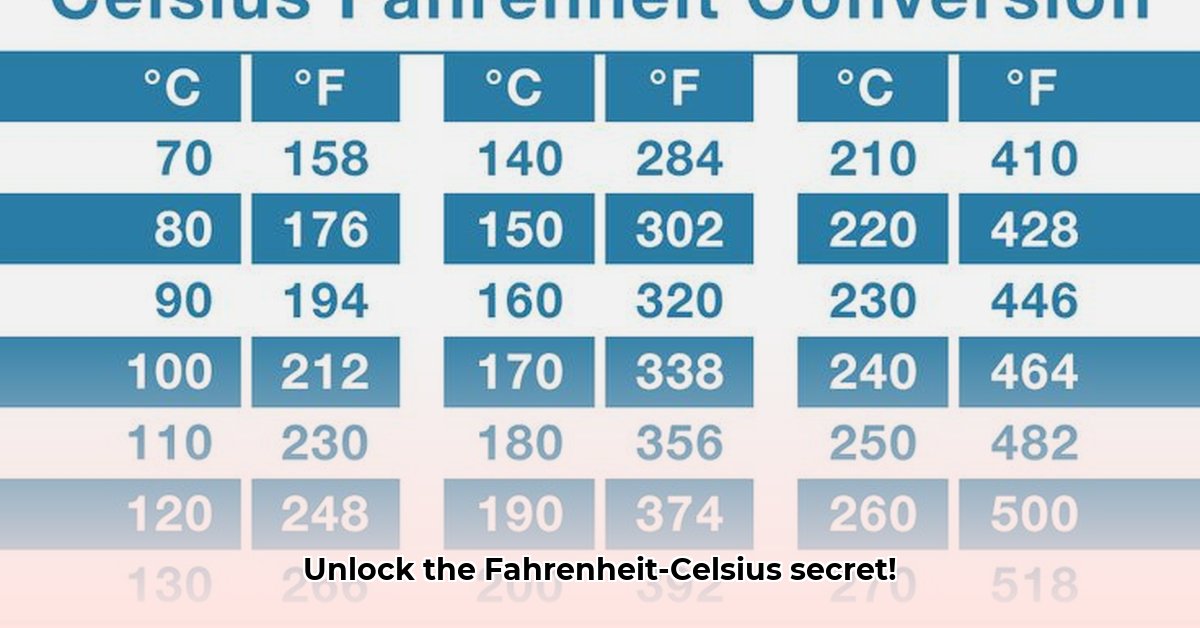
Understanding Fahrenheit and Celsius Conversions
Let's face it: juggling Fahrenheit and Celsius can be confusing. This guide provides a straightforward approach to converting between these temperature scales, equipping you with the skills to confidently tackle conversions in any situation. Whether you're baking a cake or interpreting a weather report, mastering this skill is invaluable. Did you know that a seemingly minor temperature difference can significantly impact the outcome of various tasks? For more examples, see this Fahrenheit to Celsius conversion.
Why Convert Temperatures?
Why bother learning to convert between Fahrenheit and Celsius? Because it's incredibly practical! Imagine trying to follow a recipe that uses Fahrenheit units when your oven displays Celsius. Or consider understanding international weather reports without the ability to easily convert temperature readings. Being able to seamlessly switch between these scales unlocks a better understanding of the world around you. It's a crucial skill for cooking, gardening, travel, and many other aspects of life.
The Fahrenheit to Celsius Conversion Formula
The core of the conversion lies in a simple formula: °C = (°F - 32) × 5/9. This formula may seem daunting at first, but it's straightforward to apply. Here's a step-by-step breakdown:
Subtract 32: Begin by subtracting 32 from the Fahrenheit temperature (°F). This compensates for the difference in the freezing point of water (32°F versus 0°C).
Multiply by 5/9: Take the result from step 1 and multiply it by 5/9. This adjusts for the difference in the size of a degree between the two scales.
Celsius Equivalent: The final result is your temperature in Celsius (°C).
Let's convert 72°F (a typical room temperature) to Celsius:
- Subtract 32: 72°F - 32 = 40
- Multiply by 5/9: 40 × 5/9 ≈ 22.2
- Result: 72°F is approximately 22.2°C.
Handy Fahrenheit to Celsius Conversion Chart
While the formula is ideal for precision, a quick reference chart can be helpful:
| Fahrenheit (°F) | Celsius (°C) | Fahrenheit (°F) | Celsius (°C) | |
|---|---|---|---|---|
| 32 | 0 | 77 | 25 | |
| 41 | 5 | 86 | 30 | |
| 50 | 10 | 95 | 35 | |
| 59 | 15 | 104 | 40 | |
| 68 | 20 | 212 | 100 |
Remember, this chart provides approximate values. For highly accurate conversions, rely on the formula.
Quick Estimation Techniques
For rapid, rough estimates, try this: a change of approximately 10°F is roughly equivalent to a 6°C change. This isn't perfect but offers a quick mental check for everyday situations.
Real-World Applications
The ability to convert between Fahrenheit and Celsius is far more than a scientific curiosity. It's essential for:
- Cooking: Following international recipes.
- Travel: Understanding weather forecasts in different regions.
- Healthcare: Interpreting medical information and procedures.
- Science and Engineering: Working with global datasets.
Mastering Temperature Conversions
Consistent practice is key to mastering temperature conversions. Begin with the formula for accuracy and use the chart for quicker estimations. With time, these conversions will become second nature. You will be amazed at how frequently you'll use this valuable skill, enhancing problem solving and adding to overall competence.
How to Minimize Rounding Errors in Fahrenheit to Celsius Conversions
Key Takeaways:
- The formula (°F - 32) × 5/9 = °C provides the highest accuracy.
- Approximation methods offer speed but sacrifice precision, performing best near room temperature.
- Digital tools offer the easiest and most accurate conversion method.
Precision with the Formula
For minimal rounding errors, stick to the standard formula. This method ensures the most accurate results:
- Subtract 32 from the Fahrenheit temperature.
- Multiply the result by 5/9.
- The final result is the temperature in Celsius.
Approximation Methods
Approximation methods prioritize speed; however, their accuracy varies:
- Method 1 (F to C): Subtract 30 from °F and divide by 2.
- Method 2 (C to F): Double °C and add 30.
Important: These approximations are less precise than the formula.
Method Comparison
| Method | Pros | Cons |
|---|---|---|
| Standard Formula | Most accurate, minimizes rounding errors | Requires calculation |
| Approximation Methods | Fast and simple | Less accurate, errors grow further from room temperature |
| Digital Conversion Tools | Instant and accurate, readily available | Requires a device and potentially internet access |
Choosing the Right Approach
Select the method based on your needs:
- Use the formula for precise scientific work or situations demanding accuracy.
- Employ approximations for quick everyday estimates.
- Leverage digital tools for the best blend of accuracy and convenience. Numerous online calculators and apps are readily available.